What does "brain training" actually mean?
Brain training means practising short, structured puzzles that each lean on one mental skill, such as holding a pattern in mind or spotting a rule. You reliably get better at the puzzles you practise. Whether that carries over to everyday life is a separate, much weaker claim, and that is where most of the jargon lives.
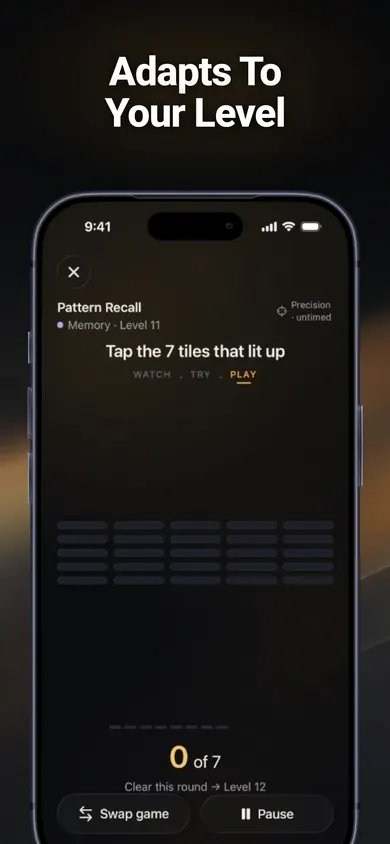
The round you just played (or skipped) leans on working memory. App listings, ours included, use a dozen terms like it. Below is each one in plain words, with the puzzle in Cognilo that uses it, so you can read any brain game listing and know what it is really offering.
Every brain game is a small test of one skill. The words just name which skill.
The brain training glossary: 16 terms, one line each
Tap a skill to filter. Each card says what the term means and where it shows up in Cognilo's eight games.
Working memory
Holding a few pieces of information in mind for seconds while you use them, like a phone number you are about to dial.
In Cognilo: Pattern Recall (hold a lit pattern, tap it back) and Market Run (remember a shopping list while keeping to a budget).
Short-term vs. working memory
Short-term memory is the brief holding. Working memory is holding plus doing something with it. Most puzzle apps test the second.
In Cognilo: Market Run asks you to remember and adapt at once.
Selective attention
Picking out what matters and letting the rest go by.
In Cognilo: Signal Sort, where you apply a rule to a stream of signals.
Inhibitory control
Stopping the response you were about to make because the rule says otherwise. The "without slipping" part.
In Cognilo: Signal Sort again; slips are what its Review replay shows you.
Cognitive flexibility
Switching between rules or ways of looking at a problem. Also called set shifting or task switching.
In Cognilo: no game is built only around switching. Rule Chain, where you find a new rule each time, is the nearest.
Executive function
The umbrella name for working memory, inhibitory control and cognitive flexibility together: the skills you use to plan and stay on task.
In Cognilo: spread across Pattern Recall, Signal Sort and Rule Chain.
Pattern reasoning
Working out the rule behind a sequence and using it to predict what comes next. Psychologists call the wider skill fluid reasoning.
In Cognilo: Rule Chain.
Mental arithmetic
Doing sums in your head without paper or a calculator. Numeracy is the broader comfort with everyday numbers.
In Cognilo: Real Numbers, which uses everyday money and time sums.
Mental rotation
Turning a shape in your mind to see whether it matches another one. Mirror images are the classic trap.
In Cognilo: Rotation Match: spot the rotated twin among mirrored impostors.
Verbal fluency
Finding, sorting and rearranging words quickly, including grouping them by meaning.
In Cognilo: Word Bridge: unscramble, categorise and spot the odd word.
Processing speed
How quickly you take something in and respond. Reaction-time games measure a slice of it.
In Cognilo: Quick Signal, which the app itself calls a recreational reaction round, and timed Sprint mode.
Speed–accuracy trade-off
Going faster usually costs mistakes, and being careful costs time. Timed games push you toward speed.
In Cognilo: untimed Precision is the default; after each round you get notes on pace versus accuracy.
Adaptive difficulty
The puzzle gets harder when you do well and easier when you struggle, so it stays at the edge of your level.
In Cognilo: every round is set to your current level, with a plain-language reason for why it was picked today.
Practice effect
Scores rise because you know the task, not because the skill changed. It is the main reason a high score can flatter you.
In Cognilo: the Benchmark uses held-out rounds you never train on.
Near and far transfer
Near transfer means practice helps a similar task. Far transfer means it helps something different, like work or driving. Near is common; far is the claim researchers doubt.
In Cognilo: we make no far-transfer claims. Ratings describe how you play Cognilo puzzles.
Performance rating
A number that tracks your level on one skill over time. It is a game score, not an IQ test.
In Cognilo: six skills are rated separately and only move when several sessions agree.
Knowing the term tells you what a game tests. It does not tell you what it changes.
What is near transfer vs. far transfer in brain training?
Near transfer is getting better at tasks close to the one you practised; far transfer is gains in unrelated, everyday tasks. A 2016 review led by Daniel Simons in Psychological Science in the Public Interest found that people improve on practised tasks but saw little evidence of real-world benefits from brain training (University of Illinois summary, October 3, 2016).
Regulators agree. In January 2016 the U.S. Federal Trade Commission said Lumos Labs had to pay $2 million to settle charges that it advertised everyday-life and age-related benefits it could not back up. The larger trials are more careful: the federally funded ACTIVE study enrolled 2,802 adults aged 65 to 94 to train memory, reasoning or processing speed and then followed them for years.
| A listing says | What it can honestly mean |
|---|---|
| "Train your memory" | You will practise memory puzzles and likely get better at them. |
| "Track your progress" | Scores on that app's games over time. |
| "Boost your brain" | Usually a far-transfer promise. Look for the evidence. |
| "Adaptive" | Difficulty follows your level. Good for staying engaged. |
Near transfer is likely; far transfer is a promise to read twice.
A Sunday morning with three app listings
Picture it: coffee, three brain game listings open in the App Store, and every one promises "cognitive" something. One says "processing speed." Another says "executive function." The third has a chart labelled "transfer."
You do not need a psychology degree for this. Ask two questions of every listing. Which skill does each game lean on? And does the app say its scores describe the games, or your life? The first question sorts the games. The second sorts the honesty.
Two questions sort any listing: which skill, and what does the score describe?
Brain training FAQ
Is brain training scientifically proven?
What is the difference between working memory and short-term memory?
What does far transfer mean?
Is a brain game rating the same as an IQ score?
Which skills does Cognilo cover?
How Cognilo turns these terms into a 6-minute session
- Open the Daily 5. Five short games picked for your level across the six skills above. Your first puzzle starts straight away, with no sign-up and no questionnaire.
- See why it was picked. Each puzzle shows a plain-language reason, so the jargon above stays out of the way. Say a round was too easy or too hard and the next one responds.
- Read the tip. After each round: a strategy tip for that game, notes on pace versus accuracy, and an unrated Review replay of any round that slipped.
About six minutes, five skills, and a reason for every pick.
Honest limits
- Ratings describe puzzles, not people. Cognilo says so in its own listing. The National Institute on Aging advises readers to be wary of claims that online games improve memory and thinking.
- One design decision: ratings only move when several sessions agree, so one good morning or one tired evening does not rewrite your profile. It makes early progress feel slow, on purpose.
- A gap: there is no game built only around cognitive flexibility, and Quick Signal is a recreational round, not a lab-grade speed test.
- Who should pick something else: anyone who wants a clinical memory assessment (that is a conversation with a clinician), or anyone who prefers one long crossword to five short games.
This is general information, not medical advice. Talk to your clinician if you are worried about memory or thinking.