Chapter 1
Are there brain games for adults with no timer?
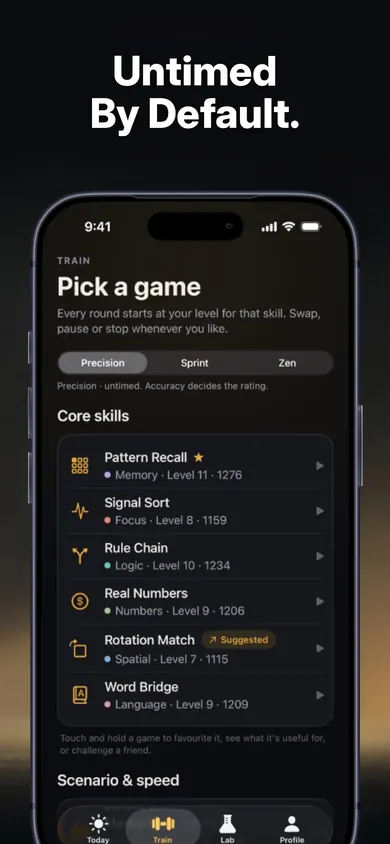
Yes. Cognilo is untimed by default: its standard Precision mode has no clock, and accuracy decides the rating. You can switch to timed Sprint when you want a push, or to unrated Zen when you just want to play.
Many brain game apps put a countdown on almost everything. That suits some people. For others, the ticking bar turns a puzzle into a test they did not sign up for. A 2017 review in Frontiers in Psychology by Caviola and colleagues found that time pressure often pushes people toward simpler, faster strategies, and that anxiety is thought to load working memory with worry, though the authors note the evidence is mixed and few studies measured it directly. We read that as a reason to make the clock optional, not as proof of anything about you.
Take the clock away and a puzzle is a puzzle again.
Chapter 2
Timed vs. untimed brain games, side by side
| Timed round | Untimed round | |
|---|---|---|
| What it rewards | Speed and accuracy together | Getting it right |
| How it feels | A push; can feel like a test | Calmer; room to think |
| Good for | Days you want a challenge | Learning a game, tired evenings, anyone who dislikes countdowns |
| In Cognilo | Sprint | Precision (default) or Zen (unrated) |
Neither is better; the point is choosing.
Chapter 3
What your ranking says
The list at the top is a small decision tool. Whatever sits first decides your starting mode and how to play the Daily 5. Your current match: Precision, the default. Change the order and this updates too.
Your top priority picks the mode; the other three just break ties.
Chapter 4
How a calm puzzle session works in 3 steps
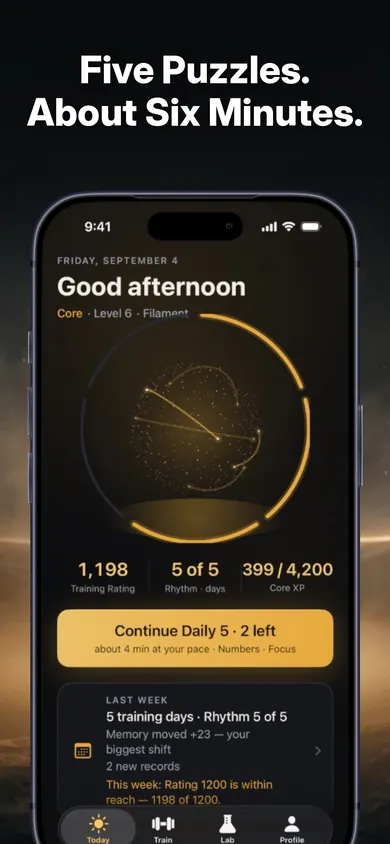
- Open the Daily 5. Five short games picked for your level across memory, focus, logic, numbers, spatial and language. The first puzzle starts straight away, with no sign-up and no questionnaire.
- Play at your pace. Each puzzle shows a plain-language reason for why it was picked today. Say a round felt too easy or too hard and the next one responds.
- Read the tip. After each round you get a strategy tip for that game, notes on pace versus accuracy, and an unrated Review replay of any round that slipped.
Five rounds, five results, one tip each.
Chapter 5
Honest limits
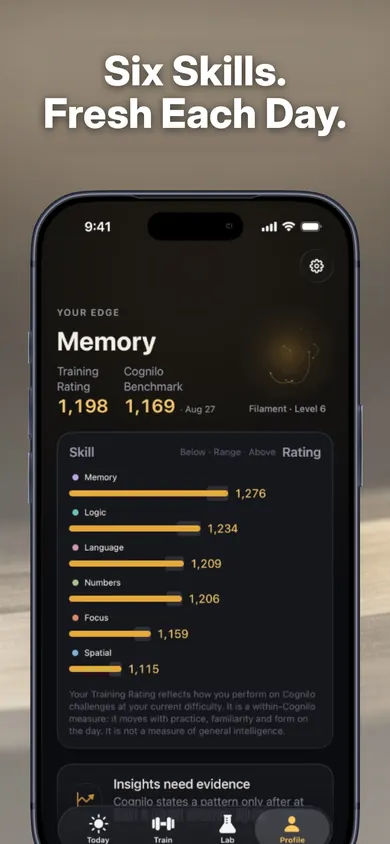
- It is a game, not a health check. Cognilo's Performance Ratings describe how you play Cognilo puzzles. They are not a measure of intelligence or health. The National Institute on Aging warns readers to beware of claims that online games improve memory and thinking (content reviewed June 2024), and we agree.
- Untimed is the default, not the only setting. Market Run days take a little longer than six minutes, and Quick Signal is a recreational reaction round, so it is about speed by nature.
- Design decision: ratings only move when several sessions agree, so one good morning or one tired evening does not rewrite your profile. That means ratings feel slow at first. That is on purpose.
- Who should pick something else: people who want a big library of classic puzzles like crosswords or sudoku, or anyone who wants a long, open-ended session. Cognilo is built around one short daily session.
If you have real concerns about memory or thinking, talk to your clinician. This is general information, not medical advice.
Chapter 6
Real screens from Cognilo
Questions
Untimed brain games: 12 straight answers
What is the best untimed brain game for adults?
How long does Cognilo's Daily 5 take?
Can I turn the timer back on?
What puzzles are in Cognilo?
Do I have to keep a streak?
Is Cognilo's rating an IQ score?
Why does my rating move slowly?
What is the Cognilo Benchmark?
Does Cognilo work offline?
Is my puzzle history private?
Is Cognilo free?
Do untimed brain games make you smarter?
Tonight, no countdown
Five puzzles. Your pace.
Download free on the App Store. No account, no ads, works offline.
More from Focus and Screen Time
- Brain training terms, in plain wordsWorking memory, far transfer, mental rotation and 13 more brain training terms in plain words, plus a 20-second round you can play right here.
- How to get better at brain gamesStuck on the same score? Eight tips for getting better at brain games, plus a 20-second go/no-go test that shows if you're too fast or too careful.
- Build a 4-minute morning brain warm-upAnswer three taps and get a 2, 4 or 8-minute morning brain warm-up that replaces the first scroll of the day. Free plan, honest limits.
- 7 deep work mistakes, and the fix for eachSeven deep work mistakes that quietly end a focus session, each with a fix that fits inside 25 minutes. Tap the ones you make to build your list.