The click that came too soon
You hold an angle for twenty seconds. Nothing. Your thumb is tight on the button, and when a shape flickers at the edge, you fire. It was a teammate. Or it was nothing at all.
Most reaction time tests would never catch that, because they only reward speed. Click early and they simply restart. In a match, the early click is the expensive one. That is why the test above mixes in red traps: a good reaction is fast on the right signal and still on the wrong one.
Fast is half the skill. Not firing is the other half.
How to test your reaction time properly
- Warm up with one throwaway run. Your first round includes figuring out the screen. Take the test once, ignore the number, then take it again.
- Read the median, not your best tap. One lucky 180 ms tap is noise. The test above reports the middle of your five blue taps, which is closer to what you will do in a real game.
- Same device, same time of day. Phones and browsers add their own delay. Compare yourself with yourself, on the same phone, at roughly the same hour, before you decide anything changed.
Your median on the same phone is the only number worth tracking.
Where SkillArena takes it further
The trap in our test is a tiny version of Deep Focus, one of SkillArena's modes: a 30-trial go/no-go precision game where you tap on go and hold on no-go. The Daily Arena around it mixes four short games from focus, memory, reasoning, numbers, careful reading and clear wording, in about four minutes.
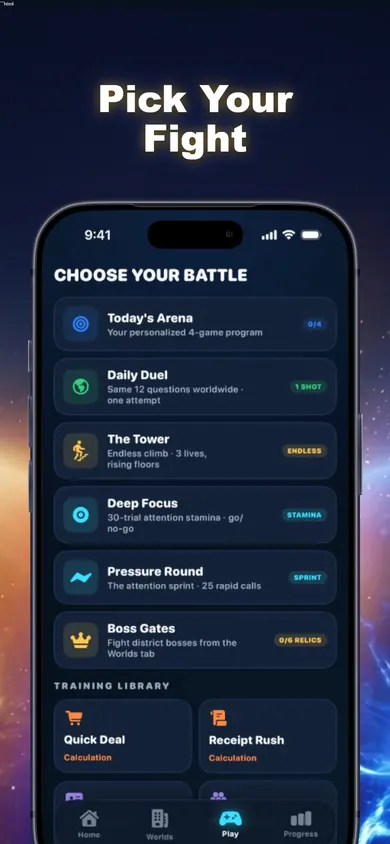
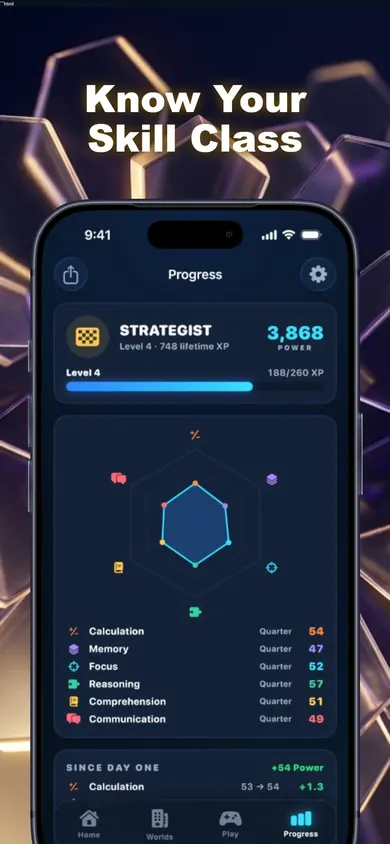
The test on this page is one trial type. The app is thirteen games.
What is a good reaction time for gamers?
There is no official gamer benchmark. In a 2015 study of 1,469 adults aged 18 to 65, Woods and colleagues (Frontiers in Human Neuroscience) measured a mean simple reaction time of 231 ms, or 213 ms after correcting for their own hardware delay. A phone browser adds an unmeasured delay of its own, so expect a higher number here.
| Factor | What the research says |
|---|---|
| Age | Simple reaction time rose by about 0.55 ms per year of age in the same 2015 study. Small, but real. |
| Sleep | A 2008 review by Lim and Dinges found sleep loss slows responses overall and adds long lapses over 500 ms. |
| Gaming | A 2010 study in Current Biology, reported by the University of Rochester, found action gamers made judgments faster without sacrificing accuracy. |
| Device | Woods' team found hardware delay alone shifted their mean by about 18 ms. Screens and touch panels differ. |
Honest limits
- This page is a toy, not a lab. Browser timing on phones is imprecise. Use it to compare your own runs, not to rank yourself against a stranger's number.
- One design decision: SkillArena's Deep Focus scores your holds on no-go, not only your speed, because a fast wrong tap is still wrong.
- SkillArena is a game. Its ratings describe your performance in SkillArena's own games. They are not an IQ score or a medical, psychological or clinical assessment.
- Who should pick something else: if you want aim training with a mouse on a PC, a dedicated desktop aim trainer fits better. SkillArena is for iPhone and iPad.
Sleep moves your number more than any trick on this page.
Four minutes a day.Track your own best.
No account, no ads, progress stays on your device, and every game works offline.
More focus guides
- How to get better at brain gamesStuck on the same score? Eight tips for getting better at brain games, plus a 20-second go/no-go test that shows if you're too fast or too careful.
- Concentration exercises before studyingFour concentration exercises to do before studying, picked by three taps and printed on one card. No phone needed, about 4 minutes, plus when to break.
- Build a 4-minute morning brain warm-upAnswer three taps and get a 2, 4 or 8-minute morning brain warm-up that replaces the first scroll of the day. Free plan, honest limits.
- Does attention span decline with age?Does attention span decline with age? A 10,430-person study says it peaks near 43, then dips gently as caution rises. Drag the curve, play 20 seconds.