You
I'm 52 and I can't read a page without drifting. Does attention span decline with age?
Honest Little Apps
Does attention span decline with age?
A little, later than most people think, and not in the way the headlines say. In a 2015 Psychological Science study of 10,430 people aged 10 to 70, the ability to keep attention on a 4-minute task rose until about 16, held steady until about 43, then declined gradually. Meanwhile people got steadily more careful: slower, but making fewer impulsive mistakes.
The curve doesn't fall off a cliff at 40. It flattens, and you trade some speed for care.
You
So why does my focus feel so much worse than ten years ago?
Honest Little Apps
Age vs screens: what changed more?
For most adults, the setting changed more than the brain did. Researcher Gloria Mark told the University of California (January 2024) that people's attention on a single screen averaged about two and a half minutes in her 2004 study and 47 seconds in her studies from 2016 to 2020. That measures switching habits in people at work on computers, not a decline that comes with birthdays.
A 40-something brain with a phone in reach and a 40-something brain without one are having very different afternoons.
You
What about the "8 seconds, worse than a goldfish" thing?
Honest Little Apps
Attention span by age: three numbers people quote
Only one of these is a measure of attention across ages.
If someone quotes a single attention span in seconds, ask what task it was measured on.
Honest Little Apps
The honest limits of all this
- The study was cross-sectional: different people at different ages, not the same people followed for decades. Its older volunteers chose to take a test online, which may tilt them toward sharper-than-average.
- Attention Age doesn't tell you your age, and it doesn't compare you with anyone. Its 0–100 Attention Index reflects your performance on its own tasks on your device. It is not a percentile and not a medical, clinical or diagnostic test.
- Scores usually rise with practice. That shows you got better at the tasks, not proof of broader change.
This is general information, not medical advice. Talk to your clinician, especially if memory or focus changes are sudden or are affecting daily life.
You
Is an app even the right thing for me?
Honest Little Apps
Who should pick something else
If you're worried about memory loss, confusion or changes someone else has noticed, skip apps and see a clinician; that's what a real assessment is for. If you just want a fun daily puzzle with no measurement at all, a crossword will do. Attention Age suits people who want a clear, repeatable baseline and an honest way to compare week to week.
You
OK. How would I check my own focus fairly?
Honest Little Apps
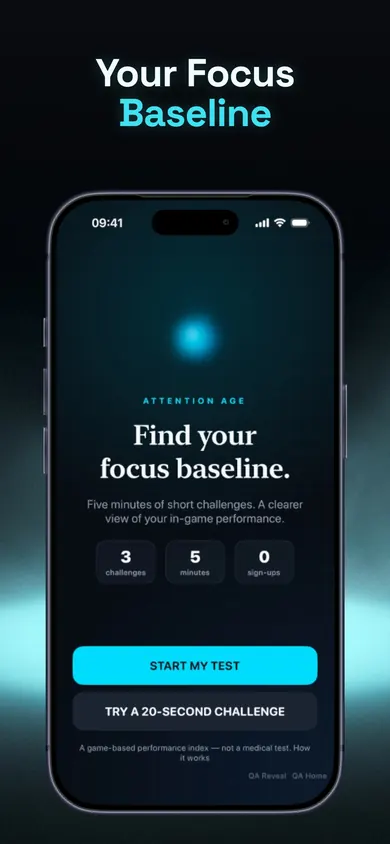
How Attention Age works, in 3 steps
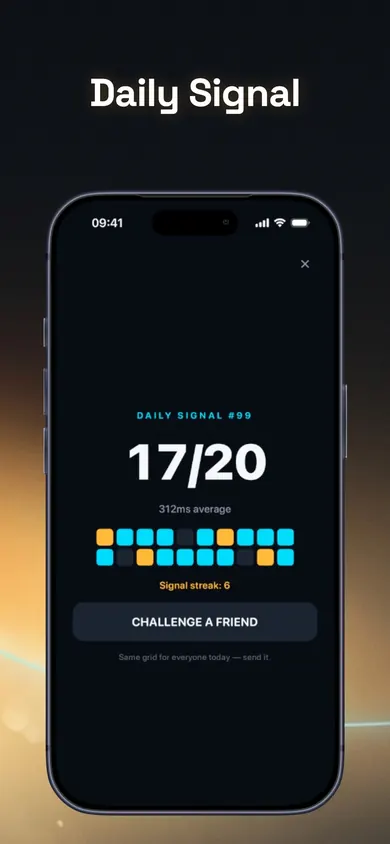
- Take the five-minute test. Three timed tasks: Signal Watch (tap the signals, skip the decoys), Interference (judge the middle arrow) and Tracking (follow moving shapes).
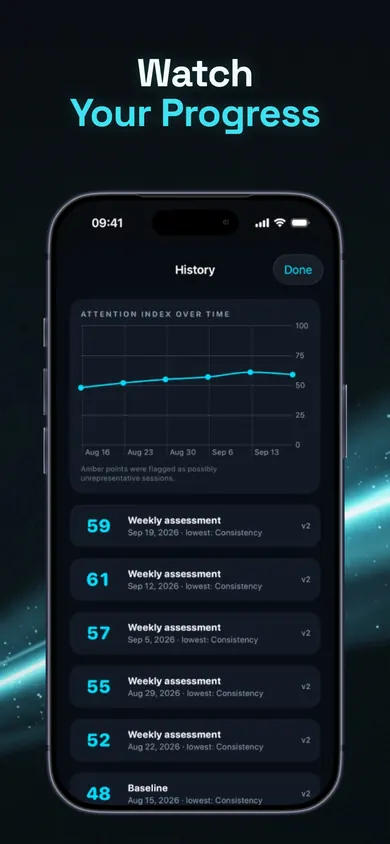
- Read five categories. Sustained Attention, Response Control, Consistency, Distractor Handling and Object Tracking, each explained in plain language, plus a validity check that flags sessions that probably weren't a real attempt.
- Re-test weekly, fairly. Same tasks, same scoring. Changes under 5 points are called "about the same", and early gains from familiarity are flagged.
You
Can I try something now?
Honest Little Apps
Play it: a 20-second steady-signal round
Like the study's task, in miniature. Shapes fade in one after another. Tap the stage (or press Space) for every square tower. Hold still for every triangle peak. Peaks are rare, which is the trap.
A 20-second toy round on a web page, not a measurement. It says nothing about your age; it only shows whether you lean fast or careful today.
Honest Little Apps
A small story about a lower score
An example, not a testimonial: someone takes the test on a Sunday, then again the next Sunday after a short night. The second Attention Index is 4 points lower. The app calls it "about the same", keeps both results in history, and suggests one practice focus. Nobody gets told they've aged a year.
A fair re-test is one that's allowed to say "nothing changed".
Attention and age, answered
At what age is attention span the best?
Is the 8-second attention span real?
Does Attention Age tell me my attention age?
Is Attention Age free?
Find your baseline.Then compare fairly.
Try it tonight: five minutes, three tasks, and a result that stays on your iPhone. No account, no ads.
More from Focus and Screen Time
- Test your attention span at home, in 4 stepsA 4-step at-home attention span test: a 5-minute page tally, a 12-arrow focus test you can take right here, and a fair way to re-test weekly.
- Can't focus on reading anymore?Can't focus on reading anymore? Why the mind drifts off a page, what research says about screens and hard text, and a 20-second drift test to play.
- A new year focus resolution you can measureA new year resolution to focus better that you can actually check: play a 20-second signal test now, then re-test fairly every week of 2027.
- 7 deep work mistakes, and the fix for eachSeven deep work mistakes that quietly end a focus session, each with a fix that fits inside 25 minutes. Tap the ones you make to build your list.