A small story about chapter four
You open the novel on the train. Page one goes fine. Somewhere on page two your eyes keep moving and your mind leaves the building: the meeting, the bill, whether you replied to that text. You reach the bottom of the page and realize you have no idea who's speaking. You go back to the top. It happens again.
That's not a moral failure or a broken brain. It has a name, it's been measured, and the fixes are less dramatic than "delete everything and read Tolstoy by candlelight." This is an example, not a testimonial, but if it sounds familiar, the rest of this page is for you.
Why can't I focus on reading anymore?
Usually because your mind is wandering while your eyes keep going, and three things make that worse: harder text, a screen, and a phone within reach. In a 2021 study in Psychological Research, 89 students reported mind wandering at 38.9% of check-ins while reading, and it rose steadily as the text got harder.
The same study found the opposite effect for interest: the more interested people were in the text, the less their minds wandered. So "I can't focus on reading" is often "I can't focus on this text, here, now", which is a far more fixable problem.
Your eyes can read a whole page while you're somewhere else. Noticing sooner is the skill.
Reading on paper vs screen: what changes?
A 2018 meta-analysis in Educational Research Review pooled 54 studies and more than 171,000 readers. Comprehension was a little better on paper than on screens, the gap was bigger when people read against the clock, and it showed up for informational texts but not for stories.
For a dense report, print it. For a novel, the format matters less than the phone in your pocket.
Seven fixes for reading focus, smallest first
- Put the phone in another room. Not face down, not on silent: out of reach. Most drift gets an exit when the phone is close.
- Read 10 minutes, not "a chapter". A short, timed block is easier to protect than an open-ended one. Stop when it ends if you want.
- Ask one question before you start. "What is this chapter going to tell me?" Interest cut mind wandering in the 2021 study, and a question is a cheap way to make some.
- Use a finger or a card under the line. It gives your eyes something to follow and makes it obvious when you've stopped taking anything in.
- Catch the drift, don't punish it. When you notice, go back to the last sentence you remember and keep going. That noticing is the skill the demo above practices.
- Match difficulty to energy. Hard text when you're fresh, easy text when you're tired. Mind wandering rose with difficulty in a straight line.
- Print what matters. For work documents you need to understand, paper had a small but repeated edge.
The honest limits
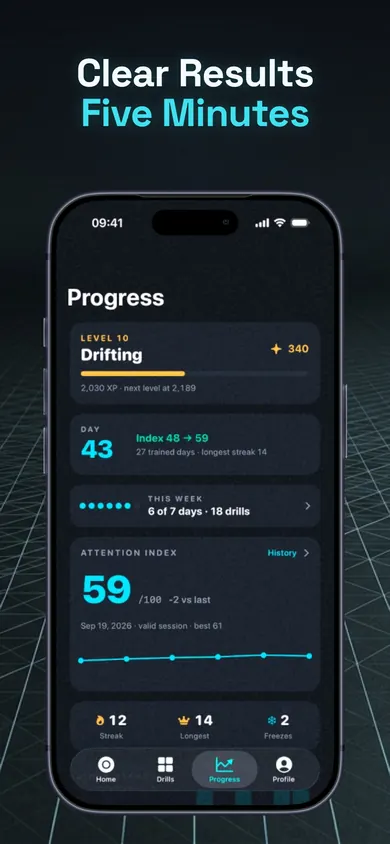
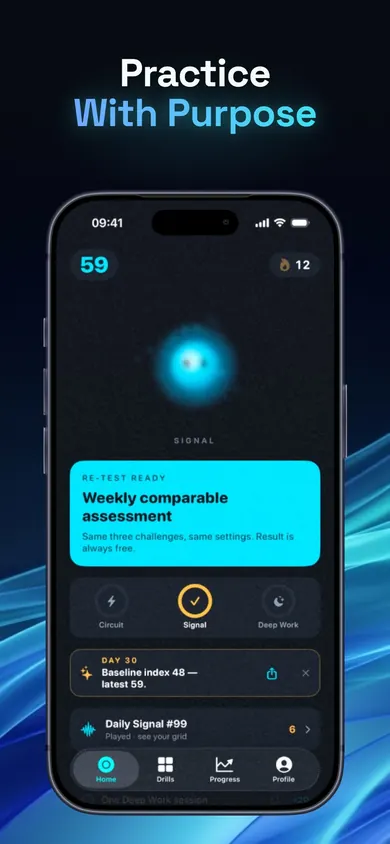
Reading focus is not one number, and no app measures it directly. Attention Age is an entertainment and self-practice app: its 0–100 Attention Index reflects your performance on its own tasks (Signal Watch, Interference and Tracking) on your device. It isn't an age, a percentile or a reading test, and it's not a medical, clinical or diagnostic tool.
What it can give you is a fair baseline and an honest weekly re-test. Changes under 5 points are called "about the same", and early gains from familiarity are flagged, so you're not fooled by getting used to the game. Scores usually rise with practice, and that shows improvement at the tasks, not proof that your reading got better.
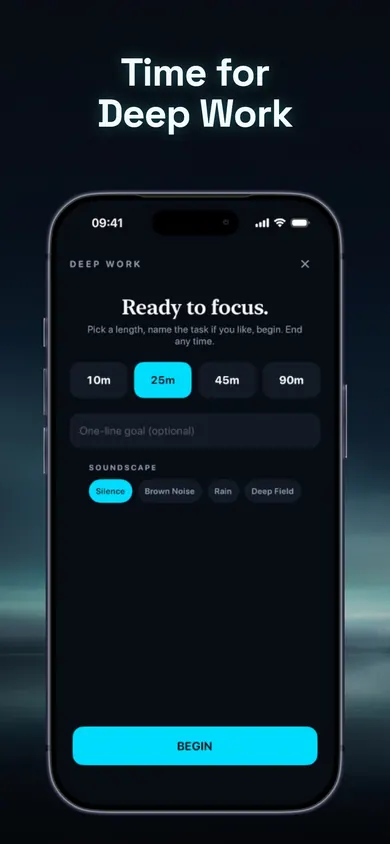
Who should pick something else: if reading has become hard together with other changes (memory, mood, sleep, vision), see a clinician or an eye doctor first. If you want to read more books, a library card and a 10-minute timer may be all you need. And if you mostly want a deep-work timer, Attention Age has one, but a plain timer works too.
This is general information, not medical advice. Talk to your clinician.
What Attention Age looks like
A five-minute test with three timed tasks, a result explained category by category, and a focus timer for when you're ready to read for real. The 10 and 25 minute Deep Work sessions are free, with optional brown noise, rain or Deep Field ambience.