Focus and Screen TimeUpdated November 2026

One baseline.52 fair re-tests.

A focus resolution you can check. Tap the cyan dots, skip the amber diamonds, for 20 seconds.

Signal check · 20 s0 / 0

Cyan dot: tap. Amber diamond: leave it.

Download on the App StoreFree on iPhone

By the Honest Little Apps studio · Updated November 2026 · A 20-second check and a 6-minute read

How do you make a new year resolution to focus better that sticks?

Make it something you practice, not something you quit, and measure it the same way every week. "Practice 25 focused minutes a day and re-test every Sunday" beats "stop scrolling", because you can do it, see it and check it, rather than only failing at it.

Resolutions get a bad reputation, but the research is kinder than the jokes. In a 2002 study in the Journal of Clinical Psychology, Norcross and colleagues found that 46% of New Year's resolvers were continuously successful at six months, compared with 4% of people who wanted the same change but made no resolution.

A resolution isn't doomed. A vague one is.

Approach goals vs avoidance goals

A large 2020 experiment in PLOS ONE followed 1,066 people for a year. Those with approach-oriented resolutions, aiming toward something, were more successful than those with avoidance-oriented ones, aiming to stop something.

Avoidance47.1%

"Stop checking my phone at work." Success only looks like nothing happening.

Approach58.9%

"Do one 25-minute focus session each workday." Success is a thing you did.

Share of participants who considered themselves successful at one year, Oscarsson et al., 2020.

Write the focus resolution as a verb you do, not a habit you don't.

Your 2027 focus plan, in four check-ins

  1. Before January 1: take a baselineThe 20-second check above is a warm-up. In Attention Age, the five-minute test gives a 0–100 Attention Index across Sustained Attention, Response Control, Consistency, Distractor Handling and Object Tracking.
  2. Every day: one approach goalName one task and start a 10 or 25 minute Deep Work session, both free. Or play the Daily Signal, a free 20-second challenge with the same pattern for everyone that day.
  3. Every week: a fair re-testSame tasks, same scoring, any day that suits you. Changes under 5 points are called "about the same", and weekly results are always free.
  4. March 31: look at the line, not the dayEvery result stays in your history, including lower ones. Early gains from familiarity are flagged, so a jump in week two doesn't fool you.

Baseline, daily practice, weekly re-test. That's the whole resolution.

Why short focus sessions, not marathons

Attention on screens is short to begin with. Gloria Mark, a professor at UC Irvine, said in a University of California interview from May 2023 that people's attention on any one screen averaged about 47 seconds in her recent studies, down from about two and a half minutes in 2004. A January plan built on 90-minute blocks asks too much, too soon. Breaks help too: a 2011 University of Illinois study in Cognition, reported by the university, found two brief breaks kept performance from declining over a 50-minute task.

Start with 25 minutes and a break. Grow from there.

What the year looks like in the app

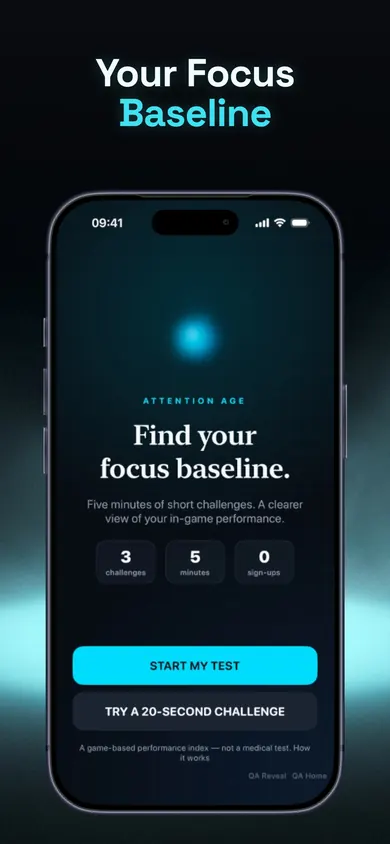
Attention Age start screen: find your focus baseline, three challenges, five minutes
The baseline: 3 tasks, 5 minutes
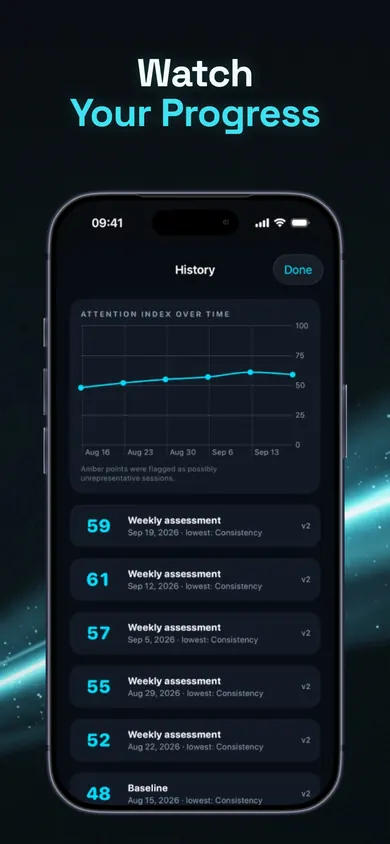
Attention Age history chart of weekly assessments over time
Weekly re-tests, lower ones included
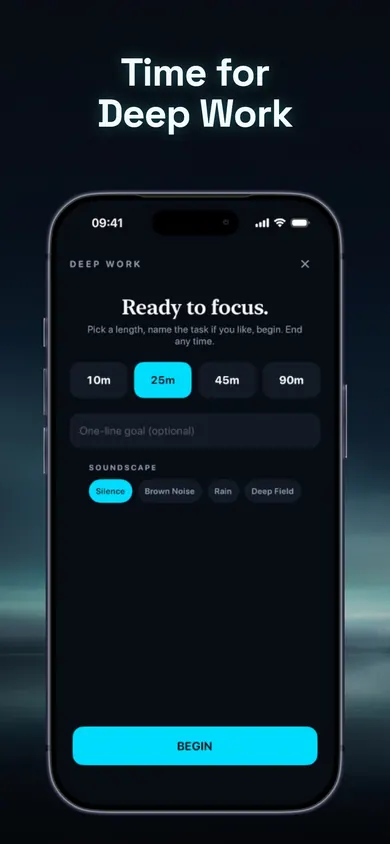
Attention Age Deep Work screen with 10, 25, 45 and 90 minute lengths
Daily practice: a Deep Work session

A January, honestly

December 30: you take the five-minute test on the sofa. The number is lower than you hoped. Your strongest category is Object Tracking; the suggested practice focus is Response Control.

The first week, you do a 25-minute session most mornings and the Daily Signal at lunch. Week two's re-test jumps, and the app flags it as early familiarity. By week six the line is still drifting up, slowly. You can't prove your whole life got more focused, and the app doesn't pretend you can. But you did 30 sessions you wouldn't otherwise have done.

The score is a mirror. The sessions are the resolution.

Who should pick something else

  • If you're worried about attention problems, see a clinician. Attention Age is an entertainment and self-practice app, not a medical, clinical or diagnostic test.
  • If you want a ranking, look elsewhere. The Attention Index is not an age, a percentile or a ranking, and it is not compared with any population.
  • If what you need is fewer distractions, an app blocker comes first. Practice helps less when the phone keeps winning.

Honest limit: scores usually rise with practice. That shows improvement at these tasks, not proof of broader change. One design decision: Lumen, the app's companion, grows when you show up, never because of your score.

Questions about focus resolutions

When should I take my baseline?
A few days before January 1, at a time of day you can repeat every week. A morning baseline compared with a late-night re-test isn't fair to either.
Is the 20-second check on this page my baseline?
No. It's a warm-up to show the idea. Your browser remembers your last result on this device, but browser timing is rough. The baseline that counts is the five-minute test in the app.
How long until I see a change?
Expect early gains in the first couple of weeks, and expect some of that to be familiarity with the tasks. Attention Age flags early familiarity gains and calls changes under 5 points about the same.
What does Attention Age cost?
It's free to download. The test, the Daily Signal, three practice tasks, weekly re-tests and 10 and 25 minute Deep Work sessions are free. Attention Age Pro is an optional subscription that adds seven more drills and longer sessions.

Take the baseline.Check it all year.

No account, no ads, no third-party analytics. Your results stay on your iPhone.

Download on the App StoreFree on iPhone · Play free on iPhone

More focus guides