Build your 4-minute warm-up card
What are good concentration exercises before studying?
Short, slightly hard tasks that use the same kind of thinking as your subject: counting down by 7s before maths, spelling key terms backwards before reading, recalling the last lecture before memorizing. Do four, about a minute each, without your phone. Then start the first real task immediately, and plan two brief breaks into longer sessions.
Why the breaks? In a University of Illinois study published in Cognition (reported February 2011), 84 people did a repetitive 50-minute task. Most groups' performance slid over time; the group that switched to something else twice, briefly, held steady. Several of the warm-ups here come from a list of eight concentration exercises published by HAW Hamburg's student counselling office, such as recalling your day in reverse.
A warm-up is a start ramp, not a workout. Four minutes, then the real page.
When a warm-up isn't the answer
If you can't start because you don't know what to do first, a warm-up won't fix that: write the first tiny task on paper instead. If you're too tired to read a sentence, sleep beats every exercise here. And if starting has been hard in every class for months, talk to your school's student support team or a clinician; that's worth more than any card.
Use the card when you know what to study and just can't get going.
SkillArena's 4-minute Daily Arena
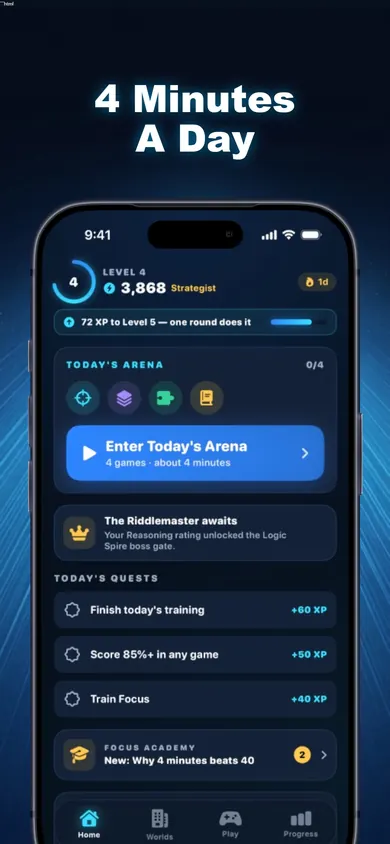
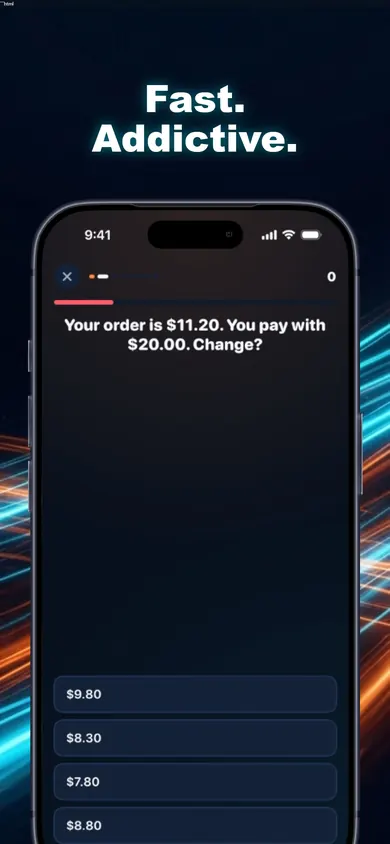
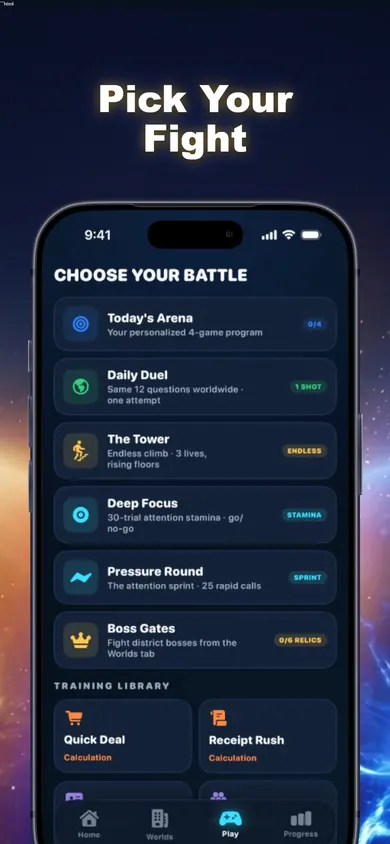
Prefer a game to paper? SkillArena's Daily Arena mixes four short, different games from focus, memory, reasoning, numbers, careful reading and clear wording, in about four minutes. Pick Quick (~2 min), Standard (~4 min) or Extended (~8 min). It works offline, has no ads and needs no account.
Paper warm-up vs game vs "just one scroll"
Statistics, the night before
8:58 PM Laptop open, problem set open, phone in hand "for one second". It's been eleven minutes.
9:10 PM Phone goes in a drawer. The card says: count down from 100 by 7s. They get to 51 and lose it; start again from 51.
9:14 PM Four warm-ups done. Question one is a standard deviation. They write the formula before reading the rest. It's 9:40 before they look up.
The card didn't make statistics easier. It made the first two minutes not-a-phone.
What these exercises can't promise
- There's no good evidence that any specific warm-up improves grades. These are start rituals, chosen because they're short, hard enough to need attention, and phone-free.
- SkillArena is a game. Its 1–100 ratings describe your performance in SkillArena's own games; they are not an IQ score or a medical, psychological or clinical assessment. Getting better at the games isn't proof your studying got better; our page on whether brain training games work goes into that.
- The break study used a lab task, not exam revision. We use it for one modest idea: plan two short switches into a long session.
Your warm-up card, ready to print
4-minute warm-up
Reading & essays · 50 minfocus-and-screen-time.pages.dev · Phone away before minute 1.
The card follows your three taps at the top of the page. Change an answer and it rewrites itself. Print it, put it on top of your notes, and tick a box for each study night you used it.
One card, five ticks, one week of starts that weren't a scroll.
Study warm-ups, answered
How long should a study warm-up be?
Should I take breaks during a long study session?
Can I use a brain game as a warm-up?
Is SkillArena free?
Four minutes.Then the real page.
Play free on iPhone: a four-minute Daily Arena when you'd rather tap than print. Offline, no account, no ads.
More from Focus and Screen Time
- Build a 4-minute morning brain warm-upAnswer three taps and get a 2, 4 or 8-minute morning brain warm-up that replaces the first scroll of the day. Free plan, honest limits.
- How to get better at brain gamesStuck on the same score? Eight tips for getting better at brain games, plus a 20-second go/no-go test that shows if you're too fast or too careful.
- A reaction time test that counts false startsA 20-second reaction time test for gamers that also counts false starts. Tap on blue, hold on red, then see your median and what slows it down.
- Block apps while studying: a finals plannerPick your exam date, study hours and hardest time of day. Get a finals-week plan of blocked study sessions for your iPhone, with honest limits.