Dear puzzle player,
You asked a fair question, and we make a brain game, so you should hear the answer from us before you hear it from an ad.
Do brain training games actually work?
Partly. You reliably get better at the games you practice. The evidence that this spreads to everyday life, like work, memory for names or staying sharp with age, is weak. A 2016 review of the field found "little evidence" for broad transfer. Play because you enjoy it; measure honestly.
That review, led by Daniel Simons and published in Psychological Science in the Public Interest in October 2016, looked at the studies brain-training companies cited. It found improvement on trained tasks, less on closely related tasks, and "little evidence to date of real-world benefits."
You get better at the puzzle. Whether you get better at life is a much harder claim.
What the research says, claim by claim
| Claim | What the evidence says |
|---|---|
| "You'll get better at the games." | Yes Practice improves performance on practiced tasks, per the 2016 Simons review. |
| "It helps at work and school." | Not shown In January 2016 the US Federal Trade Commission settled with Lumosity's maker for $2 million over claims like this that it said lacked scientific support. |
| "It prevents dementia." | Not shown The same FTC case covered claims about delaying cognitive decline and dementia. |
| "Some training effects can last." | Some evidence The NIH-funded ACTIVE trial reported in January 2014 that 10 years on, 73.6% of reasoning-trained and 70.7% of speed-trained older adults were at or above baseline on those skills, versus 61.7% and 48.8% of controls. Memory training showed no lasting difference. |
The honest scorecard: better at the games, maybe more, much less proven.
A small story about a big number
Picture a player three weeks into a daily puzzle habit. Her memory score is up by a third, and she is delighted. Then she tries a version of the puzzle she has never seen, with different shapes and a different layout, and her score lands much closer to where she started.
Nothing went wrong. She learned the game. That is real, it is satisfying, and it is not the same thing as a better memory. The trouble is only that most apps show her the first number and never the second.
Familiarity looks exactly like progress until you test on something new.
How Cognilo keeps the score honest
- Separate trained and held-out rounds. The Cognilo Benchmark uses held-out rounds you never train on, so familiarity can't flatter the result. It is the second counter in the toy above.
- Slow-moving ratings. Six skills are tracked separately, and Performance Ratings only move when several sessions agree, so one good morning doesn't rewrite your profile.
- Plain claims. Ratings describe how you play Cognilo puzzles. They are not a measure of intelligence or health, and we don't say otherwise.
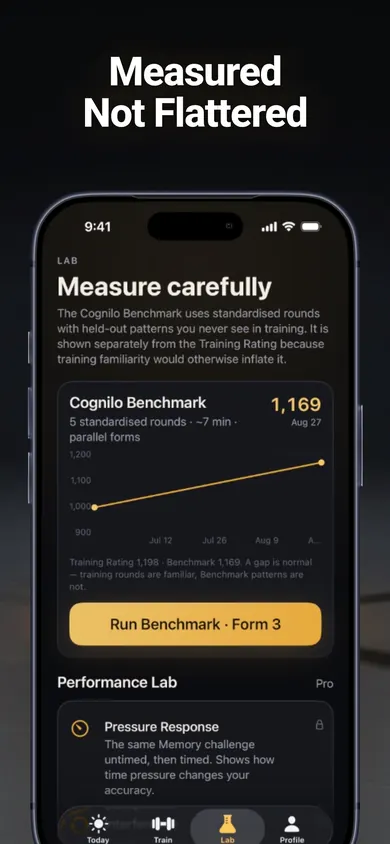
If a brain game can't show you a held-out score, it's showing you practice.
Three kinds of puzzle app, compared
Honest limits
- We can't promise transfer. Neither can anyone else, based on the evidence above. Cognilo is a daily puzzle game.
- Our held-out benchmark shows Cognilo skill, not general intelligence. It removes familiarity from the score; it doesn't prove change outside the app.
- One design decision: the Daily 5 is untimed by default, because we would rather you think than rush. Choose timed Sprint when you want a push.
This is general information, not medical advice. If you're worried about your memory or thinking, talk to your clinician.
Who should pick something else
- If your goal is protecting your health as you age, the evidence points to things like exercise, sleep and staying social more than any app. Spend the six minutes there first.
- If you want fast arcade reflex games, a timed-only game will feel livelier. Cognilo is calm by design.
- If you need a clinical assessment, that is a clinician's job, not a puzzle app's.
But if you like a short daily puzzle and want the score to tell you the truth, we built Cognilo for you: five puzzles, about six minutes, no account, no ads, and it works offline.
With care,The Honest Little Apps studio
Five puzzles.An honest score.
Free to play, with the Daily 5, all six skills, ratings and the Benchmark included.
More focus guides
- Brain training terms, in plain wordsWorking memory, far transfer, mental rotation and 13 more brain training terms in plain words, plus a 20-second round you can play right here.
- Winter brain games for seniorsWinter brain games for seniors spending more days indoors: scratch the frost for a shopping-list puzzle, then plan a calm, untimed winter rhythm.
- Untimed brain games for adults, answeredRank what you want from a puzzle session and get a matched mode. Plus 12 straight answers on untimed brain games: length, streaks, ratings, privacy.
- How to get better at brain gamesStuck on the same score? Eight tips for getting better at brain games, plus a 20-second go/no-go test that shows if you're too fast or too careful.