A letter for the snowed-in months
Winter has a way of shrinking the week. The paths are icy, the days end early, and the plans that kept you out of the house all autumn pause until spring. A lot of people fill that space with the television, or with a newspaper puzzle that's finished by 9 AM.
This page is for a different habit: a short, calm puzzle set on your phone or tablet each day, with no clock running unless you want one. It's built around the app we make, Cognilo, and we'll be straight about what it does and doesn't do.
What are good winter brain games for seniors?
Good winter brain games for older adults are short, varied and untimed, so a session fits a cold morning and doesn't punish a slow day. Mix memory, numbers, words, logic and spatial puzzles, play a few days a week, and keep a social game like cards for when visitors come by.
Short, varied, untimed. A winter puzzle habit should fit the day, not fight it.
What the research says about brain games after 60
The honest answer is mixed. The US National Institute on Aging, in its Cognitive Health and Older Adults page (reviewed June 2024), says structured cognitive training "appears to have benefits", but also tells readers to beware of claims that online games improve memory and thinking.
The study behind the hopeful part is ACTIVE. In 2014 the University of Washington reported its 10-year results: 2,832 healthy volunteers, average age 74, took ten sessions of about an hour. Ten years on, reasoning and speed training groups had declined less than the control group. Memory training showed no lasting difference.
So we don't promise that Cognilo protects your memory. It doesn't claim to, and its ratings describe how you play its puzzles, not your intelligence or health. What a daily puzzle set can honestly give you is a pleasant, absorbing routine with clear feedback, which is a fine reason to play through a long winter.
This is general information, not medical advice. If you notice changes in your memory, talk to your clinician.
Plan your winter puzzle rhythm
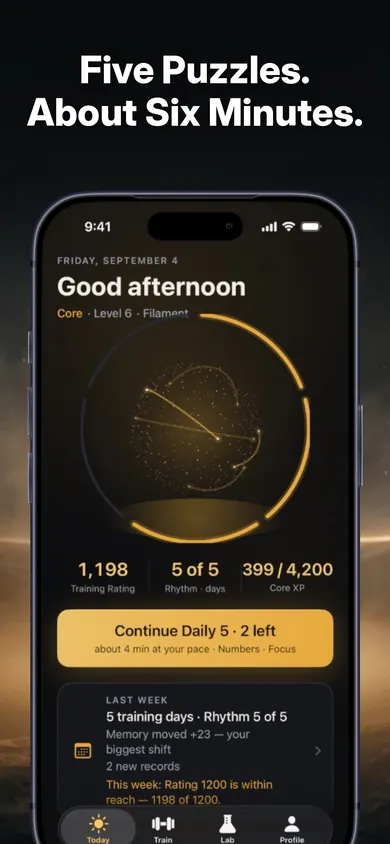
Cognilo counts days per week, which it calls Rhythm, instead of an unbroken streak. Pick how many days you'd like to play, and see a winter that allows for holidays and visitors. You can print it for the fridge.
Puzzle days per week
How the Daily 5 works, in 3 steps
Open it with your tea.
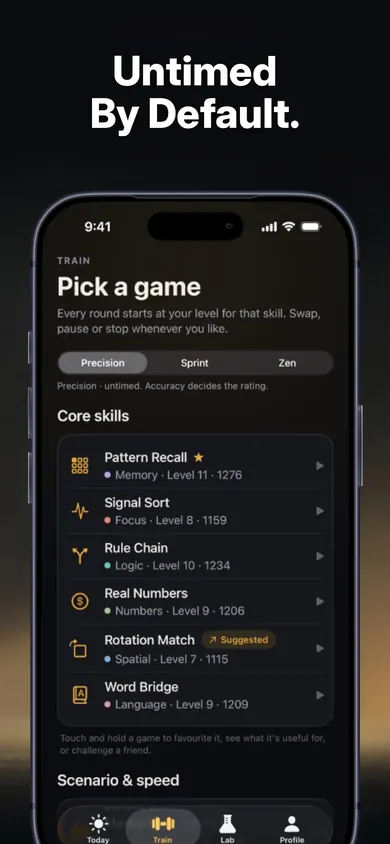
Cognilo serves the Daily 5: five short games picked for your level, from six skills (memory, focus, logic, numbers, spatial and language). It takes about six minutes at a typical pace.Play at your own speed.
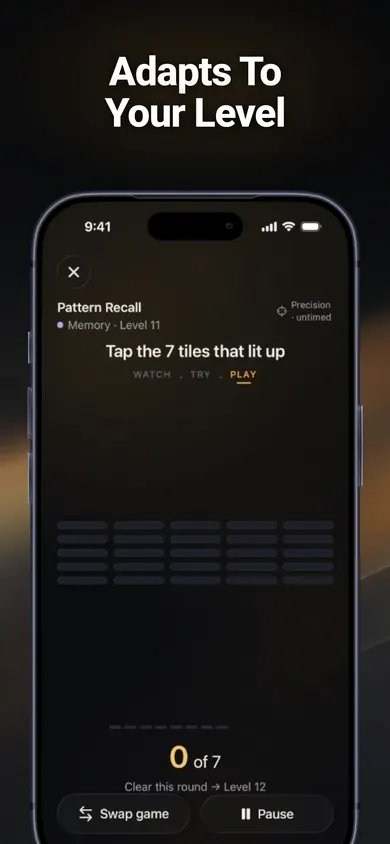
Untimed Precision is the default. Choose Sprint if you want a clock, or unrated Zen when you just want to play. Tell it a round felt too easy or too hard and the next one responds.Read the tip, then stop.
After each round you get a strategy tip and a Review replay of anything that slipped. Then you're done until tomorrow, or until next week if the grandchildren are visiting.
The shopping list at the top of this page is a cousin of Market Run, one of Cognilo's eight games: remember a list, keep to a budget, adapt when something changes.
See the real app
Winter brain games: common questions
Is Cognilo easy to read on a phone?
It's designed for phone and tablet screens, and an iPad gives you a bigger board. Rounds are untimed by default, so there's no rush to read a puzzle.
Does it work without Wi-Fi during a storm?
Yes. Cognilo works offline and needs no account. Purchases, restores and optional Game Center leaderboards need a connection.
What if I miss a week over the holidays?
Nothing breaks. Rhythm counts days per week instead of an unbroken streak, and Grace and Vacation cover busy weeks.
Is it free?
Yes. The free tier includes the Daily 5, all six skills, ratings, the Benchmark and achievements. Cognilo Pro is an optional subscription for extra reports and history.
Can it tell me if my memory is getting worse?
No. Its ratings describe how you play Cognilo puzzles and are not a measure of intelligence or health. Talk to your clinician about any memory concerns.
Who should pick something else
- If you want company, a weekly card game or a library puzzle swap will do more for a long winter than any app. The NIA notes that social activities like visiting neighbors and volunteering are linked to better cognitive health.
- If you prefer paper, a crossword book is cheaper and needs no charger.
- If you're hoping for a treatment, no puzzle app is one. Cognilo is a game.
- If you don't have an iPhone or iPad, Cognilo is Apple-only.
Honest limit: we built Cognilo so its Benchmark uses held-out rounds you never train on, so practice can't flatter the score. That also means your Benchmark may move less than you hope. That's the point.
Warmly, the Honest Little Apps studio
Five puzzles. Six minutes.Then back to the fire.
Start on your iPhone. No account, no ads, and your history stays on your device.
More from Focus and Screen Time
- Do brain training games actually work?Do brain training games actually work? You get better at the games; proof of everyday benefits is thin. What the research says, and how to play honestly.
- Untimed brain games for adults, answeredRank what you want from a puzzle session and get a matched mode. Plus 12 straight answers on untimed brain games: length, streaks, ratings, privacy.
- Brain training terms, in plain wordsWorking memory, far transfer, mental rotation and 13 more brain training terms in plain words, plus a 20-second round you can play right here.
- How to get better at brain gamesStuck on the same score? Eight tips for getting better at brain games, plus a 20-second go/no-go test that shows if you're too fast or too careful.