Can you body double by yourself?
Partly. A body double gives you three things: someone who sees you start, a clear signal to begin, and a quiet reason not to drift. Alone, you can rebuild the signal and the reason with a visible timer and a first step said out loud. The "being seen" part is the one you can only imitate.
That matters, because the honest state of the research is thin. Medical News Today's ADHD explainer (updated November 2024) says researchers have not tested body doubling in any controlled experiment. A small 2025 study in virtual reality (Ara and colleagues, 12 adults with ADHD) found people worked faster with a human or an AI body double than alone, but their accuracy didn't change, and the authors call the evidence so far inconclusive.
Solo body doubling is a weaker copy of the real thing, but it's the copy that's there at 11 PM on a Tuesday.
What solo body doubling can't do
- It can't watch you. A real person on a call notices when you stop. A timer doesn't. If being seen is the only thing that ever gets you moving, a solo setup will feel thin.
- It isn't proven. Neither is the two-person version yet. Treat everything on this page as a try-it-tonight experiment, not a treatment.
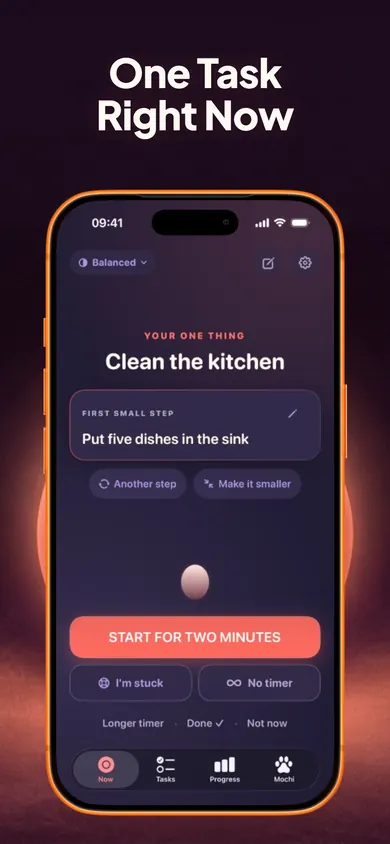
- Now is not a body double. It's a task starter: one task, one small step, a short visible timer. There's no camera, no other person and no account.
The NIMH lists medication and psychosocial treatments such as cognitive behavioral therapy as the standard ADHD treatments (page last reviewed August 2026). Starting tricks sit alongside those, never instead of them.
This is general information, not medical advice. Talk to your clinician.
A solo body double app, in 3 steps
- Name one task. Type "Pay the electric bill". Now suggests a concrete first step, which you can edit, swap or make smaller. That's the line you'd normally say to a body double.
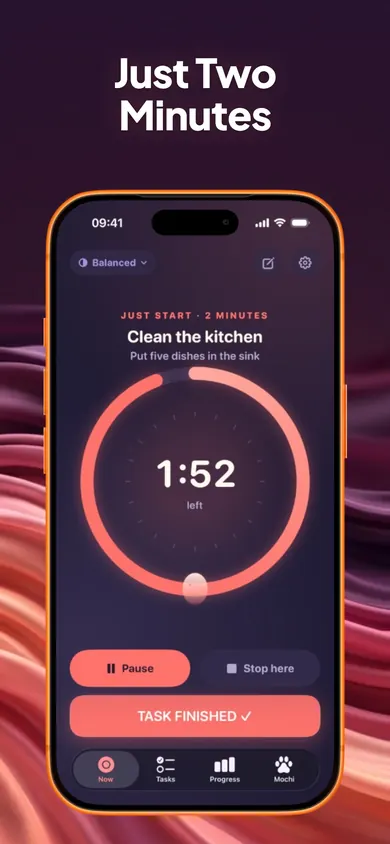
- Start for two minutes. A calm ring counts down on screen. Ending early still counts, and the timer keeps correct time when your phone is locked.
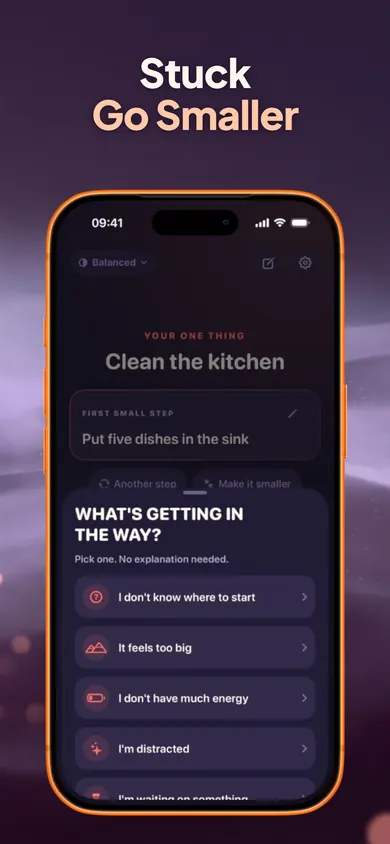
- Tap "I'm stuck" if it stalls. Pick what's in the way (too big, low energy, distracted) and get one next move, like 2 to 5 editable steps or the tiniest version of the task.
When a real person beats any app
If you've tried timers before and they slide right off you, skip the solo route and book a real one. A friend on a muted video call, a library table, or a virtual co-working session with strangers all give you the "being seen" part that no app can. Those sessions are scheduled, so they also hand you a start time.
And if starting is hard across every part of your life, not just the boring jobs, that's worth raising with a clinician rather than solving with tricks.
If being watched is the whole engine, borrow a person. If you mostly need a nudge to begin, a solo setup can do it.
A Tuesday in a one-bedroom apartment
6:40 PMThe plan was to do the tax form with a friend on a video call. The friend cancels. The form sits on the table like it's been there for a month, which it has.
6:52 PMYou type "Tax form" into Now. It suggests a first step; you make it smaller: "Find last year's PDF." You read it out loud to an empty room, which feels silly for about four seconds.
6:53 PMThe two-minute ring starts. You find the PDF in ninety seconds. The ring finishes, you pick 15 minutes, and the next time you look up, section one is done.
Nobody watched. The form still moved, because the first step was small enough to start.
Body doubling alone vs with a person
Four ways to get started, checked against the three ingredients. "Partly" means it imitates the ingredient rather than providing it.
| Option | Seen | Signal | Stay | At 11 PM? |
|---|---|---|---|---|
| Friend or co-working call | Yes | Yes | Yes | Rarely |
| "Study with me" video | Partly | No | Partly | Yes |
| Timer + first step said aloud | No | Yes | Yes | Yes |
| Waiting until someone's around | Later | No | No | No |
The best mix for people who live alone: a timer and a stated first step most nights, a real person for the jobs you've dodged for weeks.
Solo body doubling, answered
Does body doubling work for ADHD?
Is a virtual body double the same as a real one?
How do you body double without a person?
Is Now free?
No buddy tonight?Start anyway.
Try it tonight: one task, one small step, two minutes on a ring you can see. Your tasks stay on your iPhone.
More from Focus and Screen Time
- An ADHD morning routine for working from homeAn ADHD morning routine for working from home, built back from your log-on time. A 10-workday challenge, one change a day, with a first hour you can print.
- ADHD task initiation in adults, answeredWhy starting is so hard with ADHD, answered plainly for adults diagnosed later in life. Flip three myths, then get one next move for what's in the way.
- How to do a brain dump with ADHDHow to do a brain dump with ADHD, one day at a time for a week. Drag your own list into three slots for today. Nothing else gets lost.
- Task paralysis: how to get unstuckTask paralysis, and how to get unstuck: type the task, scratch for your two-minute first move, then follow 4 illustrated steps from a clinical method.