For adults diagnosed with ADHD later in life. Tap a myth to flip it.
MythFact
Free on iPhone
By the Honest Little Apps studio · Updated November 2026 · 12 questions, about 8 minutes
What is task initiation, and why is it hard with ADHD?
Task initiation is the moment of going from "I should" to actually doing the first bit. With ADHD it is often the hardest part of a task, harder than the task itself. It is not a sign you don't care. Many people with ADHD describe wanting to start, knowing how to, and still not starting.
No. Laziness means not wanting to do something. Many adults with ADHD badly want to start and still feel stuck at the edge of the task. The fix is usually a smaller first step, not more guilt.
What is ADHD task paralysis?
It is an informal name for feeling frozen in front of a task, often because it feels too big, unclear or boring to begin. It is not a formal diagnosis, but many adults with ADHD use the term to describe the feeling.
Why can I start urgent tasks but not important ones?
Urgency supplies its own push. A deadline tonight makes starting feel unavoidable, while an important task due next month offers no push at all. A short, visible timer can create a small, safe version of that urgency.
Why is it worse after a late diagnosis?
It is often not worse, just easier to see. Many adults diagnosed later have spent years building workarounds and self-blame. Naming the pattern can make the old explanations, like being lazy, feel less true.
Getting started
What is the smallest first step I can take?
Something you can do in under two minutes that physically moves the task forward. For cleaning the kitchen, that might be putting five dishes in the sink. For an email, writing only the subject line.
Does the two-minute rule work for ADHD?
It can help because two minutes is small enough to agree to. The goal is not to finish in two minutes but to start. If you stop after two minutes, that still counts as a start.
What should I do when I'm stuck and don't know why?
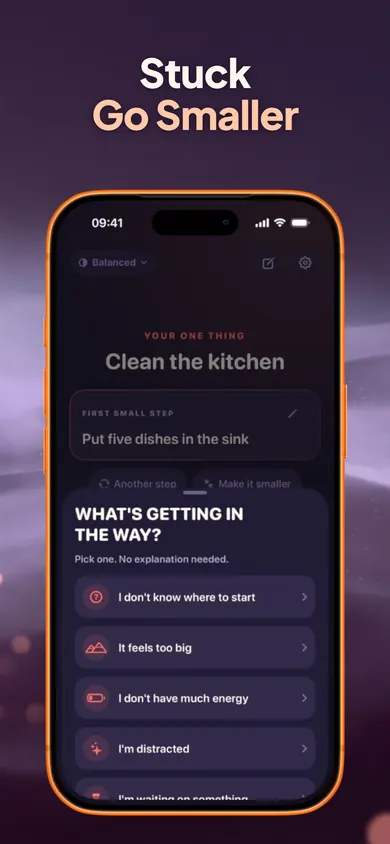
Name what is in the way: not knowing where to start, the task feeling too big, low energy, distraction, waiting on someone, or needing a break. Each one has a different next move, and the right move depends on the reason.
How many tasks should I plan for one day?
Fewer than you think. A short plan of one main task, one smaller one and an optional bonus is easier to start than a long list, and finishing it feels like a win instead of a shortfall.
Tools and help
Can an app treat ADHD?
No. Apps like Now are productivity-support tools. They do not diagnose, treat or manage ADHD. Standard ADHD treatments include medication and psychosocial interventions, which a clinician can talk through with you.
What does Now do differently from a to-do list app?
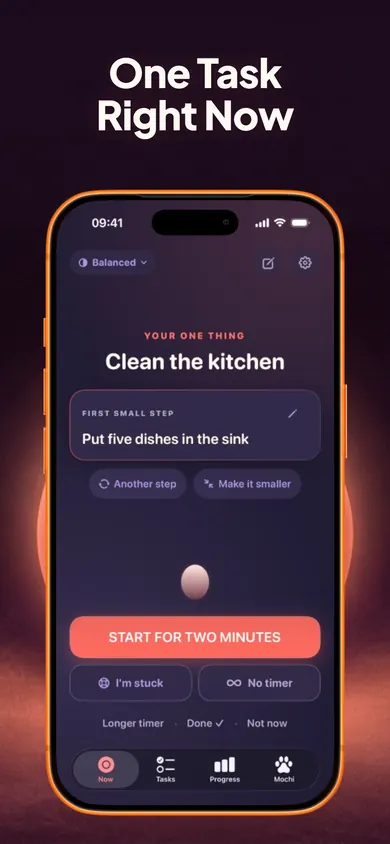
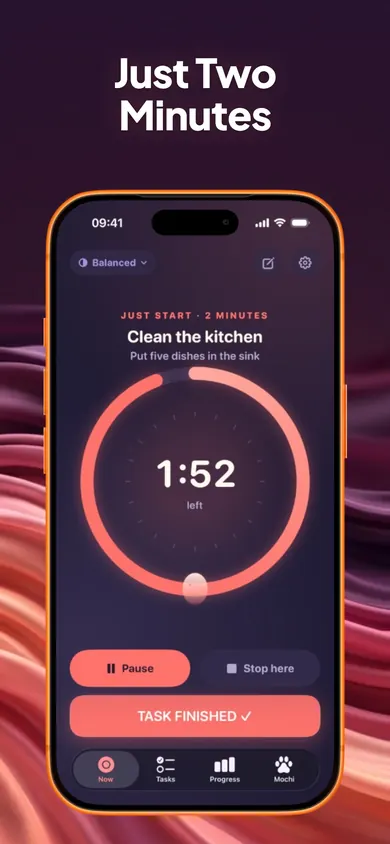
Now shows one task, one concrete first step and a big start button, with a two-minute countdown. An I'm stuck button gives one practical next move based on what is in the way. It is built around starting, not list-keeping.
Is Now free?
Yes. The one-task screen, two-minute starter, Stuck button, task breakdown, unlimited tasks, Brain Dump, focus timers, daily plan and data export are free forever. Now Pro is optional and adds routines, full Time Mirror history and more.
Does Now need an account or send my tasks anywhere?
No account is needed. Your tasks, notes and history are stored on your iPhone, and your tasks are never sent. You can export or delete them anytime.
Twelve answers, one theme: make the first step small enough to say yes to.
A Thursday, the year after diagnosis
Picture someone diagnosed at 38. They know the theory now. It is Thursday, the tax folder has been on the table for three weeks, and every evening it gets moved to the chair so dinner can happen.
Tonight they type "do taxes" into a starter app. It suggests something smaller: "open the folder and find last year's return." They tap start. The two-minute ring begins. At 1:40 they have found it. At 2:00 they keep going for ten more minutes, because now it is just the next page.
The taxes are not done. But the folder is open, and that was the wall.
The wall is usually the first two minutes, not the whole task.
Honest limits
Not treatment. Now is a productivity-support tool. It does not diagnose, treat or manage ADHD or any medical condition. If starting is affecting your work, money or relationships, that is worth raising with a clinician.
One design decision: unfinished tasks never pile onto tomorrow. They wait in a private parking lot instead. We chose a clean daily plan over a growing backlog, which means you have to choose again each day.
Starting is not finishing. A two-minute start gets you in the door. Long projects still need planning, and Now's daily plan holds up to three tasks on purpose.
Who should pick something else: people who need shared project boards, team task assignment or calendar scheduling. Now is a single-person starter, not a project manager.
This is general information, not medical advice. Talk to your clinician.
What's in the way right now?
Pick one. You get one next move, based on the same six answers Now's I'm stuck button offers. Then tap the ring to start two minutes.
What's getting in the way?
Pick one above. No explanation needed.
Different reasons need different next moves.
How Now gets you started, in 3 steps
Type one task. Type a task like "Clean the kitchen" and Now suggests a first step like "Put five dishes in the sink". Edit it, choose another, or make it smaller.
Start two minutes. A calm visual ring counts down two minutes. Pause, resume, stop early or keep going. Ending early still counts.
Keep going your way. After your start, choose 5, 10, 15 or 25 minutes, a custom length, or no timer at all. Breaks are built in.
One task, one first step
Two minutes on a calm ring
I'm stuck: pick what's in the way
One task, one small step, two minutes.
Don't wait to feel ready.Start two minutes.
Now is free to use, with no account. Your tasks stay on your iPhone.
Free on iPhone · Get Now free
More focus guides
How to do a brain dump with ADHDHow to do a brain dump with ADHD, one day at a time for a week. Drag your own list into three slots for today. Nothing else gets lost.
ADHD cleaning checklist you sort yourselfDrag eight chores into your own order and get one tiny first step plus a two-minute start. Printable ADHD cleaning checklist, free.
7 deep work mistakes, and the fix for eachSeven deep work mistakes that quietly end a focus session, each with a fix that fits inside 25 minutes. Tap the ones you make to build your list.
Test your attention span at home, in 4 stepsA 4-step at-home attention span test: a 5-minute page tally, a 12-arrow focus test you can take right here, and a fair way to re-test weekly.